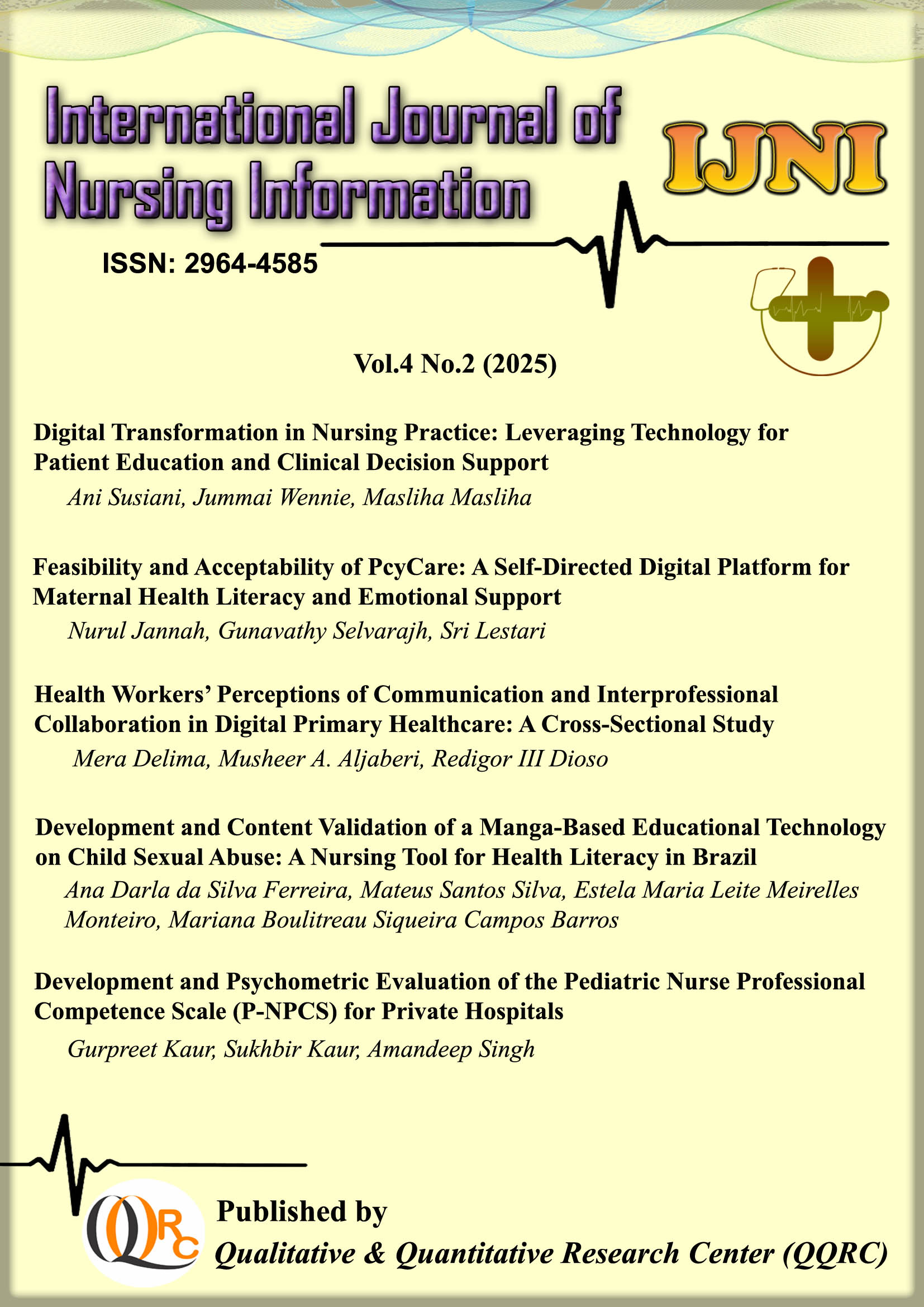
Development and Psychometric Evaluation of the Pediatric Nurse Professional Competence Scale (P-NPCS) for Private Hospitals
DOI:
https://doi.org/10.58418/ijni.v4i2.179Keywords:
Pediatric Nursing, Professional Competence, Scale Development, Psychometric Evaluation, Private Hospitals, Nursing AssessmentAbstract
Pediatric nurses require specialized competencies to meet the unique physiological and psychosocial needs of children, yet context-specific assessment tools remain limited in India, particularly for the private healthcare sector. This study aimed to develop and psychometrically validate the Pediatric Nurse Professional Competence Scale (P-NPCS) among nurses in private hospitals in selected districts of Punjab, India. A methodological research design was adopted, involving 385 pediatric nurses recruited through a non-probability, total enumerative sampling method from nine private hospitals. The development process followed a three-phase approach, including item generation based on a literature review, content validation using a three-round Delphi technique with a panel of 20 nursing experts, and scale evaluation through a pilot study and final data collection. The results of the psychometric evaluation using Confirmatory Factor Analysis supported a refined 51-item, ten-factor model with satisfactory fit indices (χ²/df = 2.93, CFI = 0.93, GFI = 0.92, RMSEA = 0.068). The findings further demonstrated high internal consistency, with composite reliability ranging from 0.78 to 0.86 and Average Variance Extracted exceeding 0.50. While 87% of the nurses demonstrated high overall competence, lower scores were identified in the domains of collaboration and professional development. In conclusion, the P-NPCS stands as a robust and reliable instrument for evaluating pediatric nursing competencies within specialized clinical environments. By offering a culturally and contextually validated tool, this study significantly contributes to the field by enabling structured performance evaluations and targeted professional development strategies, ultimately enhancing the quality of pediatric care in the private healthcare sector.
References
Abuhammad, S. (2025). Celebrating five decades of pediatric nursing progress: Achievements, persistent challenges and future directions. Journal of Pediatric Nursing, 85, 69–74. https://doi.org/10.1016/j.pedn.2025.07.007
Al-Shammari, M. A., Jaafar, J. S., & Elfeshawy, R. (2024). The role of electronic health records in improving pediatric nursing care: a systematic review. Egyptian Pediatric Association Gazette, 72(1), 77. https://doi.org/10.1186/s43054-024-00318-7
Albalawi, M. M., & Rezq, K. A. (2024). Evaluating Clinical Skill Competence and Professional Behaviors in Nursing Students Following Simulation Training at the University of Tabuk. SAGE Open Nursing, 10. https://doi.org/10.1177/23779608241274194
Alhojairi, H. M., Elseesy, N. A. M., Mahran, S. M., Banakhar, M. A., & Alsharif, F. (2024). Assessment of nurses’ workplace silence behaviour motives: A cross-sectional study. International Journal of Nursing Sciences, 11(5), 553–562. https://doi.org/10.1016/j.ijnss.2024.10.006
Alsadaan, N., Ramadan, O. M. E., Alqahtani, M., Shaban, M., Elsharkawy, N. B., Abdelaziz, E. M., & Ali, S. I. (2023). Impacts of Integrating Family-Centered Care and Developmental Care Principles on Neonatal Neurodevelopmental Outcomes among High-Risk Neonates. Children, 10(11), 1751. https://doi.org/10.3390/children10111751
Aslam, M. (2023). Cochran’s Q test for analyzing categorical data under uncertainty. Journal of Big Data, 10(1), 147. https://doi.org/10.1186/s40537-023-00823-3
Balakhdar, K. O., & Alharbi, M. F. (2023). A Study of Professional Quality of Life and Environmental Factors among Pediatric Registered Nurses. Journal of Nursing Management, 2023, 1–7. https://doi.org/10.1155/2023/5511932
Bartosiewicz, A., Skowron, J., Oleksy, Ł., Adamska, O., Stolarczyk, A., & Sulikowski, P. (2025). Polish Adaptation of the Nurse Professional Competence Scale. Medical Science Monitor, 31. https://doi.org/10.12659/MSM.951295
Beal, J. A. (2022). Pediatric Specialty Nursing Associations and their Role in Leadership Development. MCN: The American Journal of Maternal/Child Nursing, 47(6), 327–336. https://doi.org/10.1097/NMC.0000000000000860
Benner, P. (1982). From novice to expert. AJN The American Journal of Nursing, 82(3), 402–407.
Chávez-Valenzuela, P., Kappes, M., Sambuceti, C. E., & Díaz-Guio, D. A. (2025). “Challenges in the implementation of inter-professional education programs with clinical simulation for health care students: A scoping review“. Nurse Education Today, 146, 106548. https://doi.org/10.1016/j.nedt.2024.106548
Chew, B. H., Tang, C. J., Lim, W. S., Yap, J. K. Y., Zhou, W., & Liaw, S. Y. (2019). Interprofessional bedside rounds: Nurse-physician collaboration and perceived barriers in an Asian hospital. Journal of Interprofessional Care, 33(6), 820–822. https://doi.org/10.1080/13561820.2019.1566218
Chow, K. M., Ahmat, R., Leung, A. W. Y., & Chan, C. W. H. (2023). Is high-fidelity simulation-based training in emergency nursing effective in enhancing clinical decision-making skills? A mixed methods study. Nurse Education in Practice, 69, 103610. https://doi.org/10.1016/j.nepr.2023.103610
Chuang, J. Y., Liang, H. Y., Dai, H. Da, Tseng, T. Y., & Yu, S. (2025). A Professional Nurse Competence Scale (PNCS): Development and psychometric testing. BMC Nursing, 24(1), 624. https://doi.org/10.1186/s12912-025-03231-5
Compton, R. M., Hubbard Murdoch, N., Press, M. M., Lowe, M. E., Ottley, K. M., Barlow, M., Gartner, M., Cranley, L. C., Shi, Y., & Craswell, A. (2023). Capacity of nurses working in long‐term care: A systematic review qualitative synthesis. Journal of Clinical Nursing, 32(9–10), 1642–1661. https://doi.org/10.1111/jocn.16144
Connor, L., Dean, J., McNett, M., Tydings, D. M., Shrout, A., Gorsuch, P. F., Hole, A., Moore, L., Brown, R., Melnyk, B. M., & Gallagher‐Ford, L. (2023). Evidence‐based practice improves patient outcomes and healthcare system return on investment: Findings from a scoping review. Worldviews on Evidence-Based Nursing, 20(1), 6–15. https://doi.org/10.1111/wvn.12621
Corkin, D., & Cardwell, P. (2023). Principles of Care Planning. In Care Planning in Children and Young People’s Nursing 2e (pp. 1–16). Wiley. https://doi.org/10.1002/9781119819653.ch1
Duderstadt, K. G., & Keeton, V. F. (2023). Pediatric Physical Examination-E-Book: Pediatric Physical Examination-E-Book. Elsevier Health Sciences.
Eminoğlu, A., Kuşlu, S., & Serap Koçak, H. (2025). The relationship between compassion competence, satisfaction, and professional commitment levels. Nursing Ethics, 32(7), 2175–2187. https://doi.org/10.1177/09697330251326236
Endalamaw, A., Khatri, R. B., Mengistu, T. S., Erku, D., Wolka, E., Zewdie, A., & Assefa, Y. (2024). A scoping review of continuous quality improvement in healthcare system: conceptualization, models and tools, barriers and facilitators, and impact. BMC Health Services Research, 24(1), 487. https://doi.org/10.1186/s12913-024-10828-0
Fosah, R., & Llahana, S. (2025). Barriers and Enablers to Leadership in Advanced Practice Nursing: A Systematic Review. International Nursing Review, 72(2). https://doi.org/10.1111/inr.70034
Gemmete, J. J. (2024). Learning from medical errors. CVIR Endovascular, 7(1), 8. https://doi.org/10.1186/s42155-023-00406-6
Gershuni, O., Orr, J. M., Vogel, A., Park, K., Leider, J. P., Resnick, B. A., & Czabanowska, K. (2023). A Systematic Review on Professional Regulation and Credentialing of Public Health Workforce. International Journal of Environmental Research and Public Health, 20(5), 4101. https://doi.org/10.3390/ijerph20054101
Gregoriou, P., Charalambous, A., Rousou, E., Papastavrou, E., & Merkouris, A. (2025). Attitudes of Physicians and Nurses Toward Interprofessional Collaboration: a Systematic Literature Review. Materia Socio Medica, 37(1), 64. https://doi.org/10.5455/msm.2025.37.64-73
Griffith, P. B., Mariani, B., & Kelly, M. M. (2022). Diagnostic Reasoning Outcomes in Nurse Practitioner Education: A Scoping Review. Journal of Nursing Education, 61(10), 579–586. https://doi.org/10.3928/01484834-20220803-08
Haakenstad, A., Irvine, C. M. S., Knight, M., Bintz, C., Aravkin, A. Y., Zheng, P., Gupta, V., Abrigo, M. R. M., Abushouk, A. I., Adebayo, O. M., Agarwal, G., Alahdab, F., Al-Aly, Z., Alam, K., Alanzi, T. M., Alcalde-Rabanal, J. E., Alipour, V., Alvis-Guzman, N., Amit, A. M. L., … Lozano, R. (2022). Measuring the availability of human resources for health and its relationship to universal health coverage for 204 countries and territories from 1990 to 2019: a systematic analysis for the Global Burden of Disease Study 2019. The Lancet, 399(10341), 2129–2154. https://doi.org/10.1016/S0140-6736(22)00532-3
Halldorsdottir, S., & Bryngeirsdottir, H. S. (2025). Ethical competence in nursing: A theoretical definition. Nursing Ethics, 32(7), 2134–2162. https://doi.org/10.1177/09697330251346437
Heck, L. O., Carrara, B. S., Mendes, I. A. C., & Arena Ventura, C. A. (2022). Nursing and advocacy in health: An integrative review. Nursing Ethics, 29(4), 1014–1034. https://doi.org/10.1177/09697330211062981
Heier, L., Schellenberger, B., Schippers, A., Nies, S., Geiser, F., & Ernstmann, N. (2024). Interprofessional communication skills training to improve medical students’ and nursing trainees’ error communication - quasi-experimental pilot study. BMC Medical Education, 24(1), 10. https://doi.org/10.1186/s12909-023-04997-5
Hosseinzadegan, F., Habibzadeh, H., & Jasemi, M. (2024). The contribution of the nursing profession to the establishment of social justice: A grounded theory study. Nursing Ethics, 31(5), 759–776. https://doi.org/10.1177/09697330231200566
Hriberšek, M., Eibensteiner, F., Bukowski, N., Yeung, A. W. K., Atanasov, A. G., & Schaden, E. (2024). Research areas and trends in family-centered care in the 21st century: a bibliometric review. Frontiers in Medicine, 11. https://doi.org/10.3389/fmed.2024.1401577
Ivanišević, K., Kosić, R., Bošković, S., & Bukvić, M. (2022). Implementation of the Nurse Professional Competence Scale in the Republic of Croatia. Sage Open, 12(3). https://doi.org/10.1177/21582440221118544
Jalali, A., Zendeh, M. B., Sharifi, A., Naghibzadeh, A., Moradi, L., Karimi, J., Taghvostani, N. M., & Moradi, K. (2025). Psychometric properties of the Persian version of the training needs assessment for critical care nurses. BMC Medical Education, 25(1), 1149. https://doi.org/10.1186/s12909-025-07657-y
Joo, Y., Han, E., & Jang, Y. (2025). Educational programs to improve nursing competency of patient- and family-centered care in intensive care units: A systematic review. Nurse Education Today, 151, 106699. https://doi.org/10.1016/j.nedt.2025.106699
Jose, A., Tortorella, G. L., Vassolo, R., Kumar, M., & Mac Cawley, A. F. (2022). Professional Competence and Its Effect on the Implementation of Healthcare 4.0 Technologies: Scoping Review and Future Research Directions. International Journal of Environmental Research and Public Health, 20(1), 478. https://doi.org/10.3390/ijerph20010478
Junaid, S. B., Imam, A. A., Balogun, A. O., De Silva, L. C., Surakat, Y. A., Kumar, G., Abdulkarim, M., Shuaibu, A. N., Garba, A., Sahalu, Y., Mohammed, A., Mohammed, T. Y., Abdulkadir, B. A., Abba, A. A., Kakumi, N. A. I., & Mahamad, S. (2022). Recent Advancements in Emerging Technologies for Healthcare Management Systems: A Survey. Healthcare, 10(10), 1940. https://doi.org/10.3390/healthcare10101940
Keumalasari, K., Yetti, K., Novieastari, E., & Martha, E. (2025). The Strategies and Interventions for Interprofessional Collaboration to Improving Patient Safety in Hospitals: A Systematic Review. Jurnal Keperawatan Indonesia, 28(2), 141–156. https://doi.org/10.7454/jki.v28i2.1148
Krishnamoorthy, S., Dua, A., & Gupta, S. (2023). Role of emerging technologies in future IoT-driven Healthcare 4.0 technologies: a survey, current challenges and future directions. Journal of Ambient Intelligence and Humanized Computing, 14(1), 361–407. https://doi.org/10.1007/s12652-021-03302-w
Larcher, V. (2025). Children Are Not Small Adults: Significance of Biological and Cognitive Development in Medical Practice. In T. Schramme & M. J. Walker (Eds.), Handbook of the Philosophy of Medicine (pp. 435–457). Springer Netherlands. https://doi.org/10.1007/978-94-024-2252-8_16
Laserna Jiménez, C., López Poyato, M., Casado Montañés, I., Guix‐Comellas, E. M., & Fabrellas, N. (2021). Paediatric nursing clinical competences in primary healthcare: A systematic review. Journal of Advanced Nursing, 77(6), 2662–2679. https://doi.org/10.1111/jan.14768
Leszczyńska-Knaga, E., Jakubczyk, N., Kurowski, M., Kaczupska, K., Gliwa, A., Ryglewicz, M., Fabian, D., Rutkowska-Kawalec, W., Moczydłowski, P., & Michalczuk, K. (2025). The Impact of Medical Simulations on Reducing Medical Errors. Journal of Education, Health and Sport, 79, 58205. https://doi.org/10.12775/JEHS.2025.79.58205
Maffeo, M., Parente, E., & Ciofi, D. (2025). Identifying missed care in pediatric nursing: A scoping review. Journal of Pediatric Nursing, 80, 115–120. https://doi.org/10.1016/j.pedn.2024.11.017
Moynihan, K. M., Taylor, L., Crowe, L., Balnaves, M.-C., Irving, H., Ozonoff, A., Truog, R. D., & Jansen, M. (2021). Ethical climate in contemporary paediatric intensive care. Journal of Medical Ethics, 47(12), e14–e14. https://doi.org/10.1136/medethics-2020-106818
Mrayyan, M. T., Abunab, H. Y., Abu Khait, A., Rababa, M. J., Al-Rawashdeh, S., Algunmeeyn, A., & Abu Saraya, A. (2023). Competency in nursing practice: a concept analysis. BMJ Open, 13(6), e067352. https://doi.org/10.1136/bmjopen-2022-067352
O’Daniel, J. M., Ackerman, S., Desrosiers, L. R., Rego, S., Knight, S. J., Mollison, L., Byfield, G., Anderson, K. P., Danila, M. I., Horowitz, C. R., Joseph, G., Lamoure, G., Lindberg, N. M., McMullen, C. K., Mittendorf, K. F., Ramos, M. A., Robinson, M., Sillari, C., & Madden, E. B. (2022). Integration of stakeholder engagement from development to dissemination in genomic medicine research: Approaches and outcomes from the CSER Consortium. Genetics in Medicine, 24(5), 1108–1119. https://doi.org/10.1016/j.gim.2022.01.008
Öz, G. Ö., Arslanli, S. E., & Pekyiğit, A. (2024). Pediatric nurses’ experiences of implementing the ‘ten right principles’ in safe medication management: A descriptive phenomenological study. Journal of Pediatric Nursing, 78, 97–105. https://doi.org/10.1016/j.pedn.2024.06.004
Palermo, T. M., Li, R., Birnie, K. A., Crombez, G., Eccleston, C., Kashikar-Zuck, S., Stone, A. L., & Walco, G. A. (2024). Updated recommendations on measures for clinical trials in pediatric chronic pain: a multiphase approach from the Core Outcomes in Pediatric Persistent Pain (Core-OPPP) Workgroup. Pain, 165(5), 1086–1100. https://doi.org/10.1097/j.pain.0000000000003105
Procaccini, D., Kim, J. M., Lobner, K., Rowcliffe, M., & Mollenkopf, N. (2022). Medication Errors in Overweight and Obese Pediatric Patients: A Narrative Review. The Joint Commission Journal on Quality and Patient Safety, 48(3), 154–164. https://doi.org/10.1016/j.jcjq.2021.12.005
Prosen, M., Kvas, A., Bošković, S., & Ličen, S. (2021). Cross-cultural adaptation and psychometric evaluation of the Slovenian version of the nurse professional competence scale. BMC Nursing, 20(1), 142. https://doi.org/10.1186/s12912-021-00664-6
Reaves, C., Martel, M., & Rose, K. (2024). Teaching Psychomotor Skills in Undergraduate Nursing Education: An Integrative Review. Journal of Nursing Education, 63(7), 421–426. https://doi.org/10.3928/01484834-20240505-01
Ries, N., Johnston, B., Jeon, Y., Mansfield, E., Nay, R., Parker, D., Schnitker, L., & Sinclair, C. (2023). Advance planning for research participation: Time to translate this innovation into practice. Australasian Journal on Ageing, 42(1), 225–233. https://doi.org/10.1111/ajag.13161
Smith, L. C., Watson, H., Fair, L., Carter, G., Mackay, P., Lykens, K., Bradstock, J., Arnold, K., & Whalen, M. (2022). Evidence-based practices in developing and maintaining clinical nurse preceptors: An integrative review. Nurse Education Today, 117, 105468. https://doi.org/10.1016/j.nedt.2022.105468
Tangpaisarn, T., Phrampus, P. E., & O’Donnell, J. M. (2025). Interprofessional Education (IPE). In T. Tangpaisarn, P. E. Phrampus, & J. M. O’Donnell (Eds.), Navigating Healthcare Simulation: A Practical Guide for Effective Teaching (pp. 93–97). Springer Nature Switzerland. https://doi.org/10.1007/978-3-031-81265-1_12
Thacharodi, A., Singh, P., Meenatchi, R., Tawfeeq Ahmed, Z. H., Kumar, R. R. S., V, N., Kavish, S., Maqbool, M., & Hassan, S. (2024). Revolutionizing healthcare and medicine: The impact of modern technologies for a healthier future—A comprehensive review. Health Care Science, 3(5), 329–349. https://doi.org/10.1002/hcs2.115
Tran, Q. H. N. (2025). Validation and reliability of performance management’s scale on academic libraries. Library Management, 46(6–7), 438–451. https://doi.org/10.1108/LM-02-2025-0024
Van Horn, E., & Lewallen, L. P. (2023). Clinical Evaluation of Competence in Nursing Education: What Do We Know? Nursing Education Perspectives, 44(6), 335–340. https://doi.org/10.1097/01.NEP.0000000000001156
Ward, C. E., Taylor, M., Keeney, C., Dorosz, E., Wright-Johnson, C., Anders, J., & Brown, K. (2023). The Effect of Documenting Patient Weight in Kilograms on Pediatric Medication Dosing Errors in Emergency Medical Services. Prehospital Emergency Care, 27(2), 263–268. https://doi.org/10.1080/10903127.2022.2028045
Wong, P. S., Chen, Y. S., & Saw, P. S. (2021). Influencing factors and processes of interprofessional professional education (IPE) implementation. Medical Teacher, 43(sup1), S39–S45. https://doi.org/10.1080/0142159X.2019.1672864
Wood, L. K., & Adelman, D. S. (2025). Incorporating the International Council of Nurses’ Competencies Into the Nursing Program Curriculum. Journal of Nursing Education, 64(4), 243–245. https://doi.org/10.3928/01484834-20241121-01
World Health Organization. (2022). Global competency and outcomes framework for universal health coverage. World Health Organization.
Wynne, K., Mwangi, F., Onifade, O., Abimbola, O., Jones, F., Burrows, J., Lynagh, M., Majeed, T., Sharma, D., Bembridge, E., Stubbs, M., Sunner, C., Bergmann, J., Bagade, T., & Malau-Aduli, B. S. (2024). Readiness for professional practice among health professions education graduates: a systematic review. Frontiers in Medicine, 11. https://doi.org/10.3389/fmed.2024.1472834
Yakov, G., Halevi Hochwald, I., Rashi, T., Shachaf, S., Sela, Y., & Halperin, O. (2025). Nursing professions’ distinctive ethical standards: Exploring a code of ethics. Nursing Ethics, 32(4), 1210–1229. https://doi.org/10.1177/09697330241277986
Zarrinkolah, E., Ghafourifard, M., & Dehghannezhad, J. (2025). The relationship between compassion competence, caring behaviours, and professional commitment among nursing students: a cross-sectional study. BMC Medical Education, 25(1), 671. https://doi.org/10.1186/s12909-025-07253-0
Zhang, Y., Zhang, Z., Peng, Y., Zhang, W., Ma, G., Lin, S., Chan, C. W. H., Cheung, A. T., Xie, J., & Gu, C. (2025). Impact of technology- and parent-based psychosocial interventions on family dynamics factors in children with cancer: A systematic review. PLOS One, 20(5), e0323483. https://doi.org/10.1371/journal.pone.0323483
Zheng, A., & Pansier, B. (2022). Global child and family-centered care fellowship, education and mentorship for pediatric healthcare professionals: A literature review. Patient Experience Journal, 9(2), 82–86. https://doi.org/10.35680/2372-0247.1616
Downloads
Published
How to Cite
Issue
Section
License
Copyright (c) 2025 International Journal of Nursing Information

This work is licensed under a Creative Commons Attribution-ShareAlike 4.0 International License.